
Monitoring infrastructure during construction is not a single task. It is a sequence of decisions, and each one depends on the quality of the last.
Most tools treat data collection, analysis, visualisation, alerting and reporting as separate steps. Sensly.io is designed differently. Sensly is built as a connected system that improves how monitoring work flows from data capture to reporting, reducing rework, preserving context, and helping engineers act with more confidence.
Configure and deploy sensors using structured tools designed for large-scale instrumentation programs. Sensly reduces manual setup effort while improving consistency across sensor networks.
Manual sensor configuration introduces variability that is difficult to detect and harder to correct.
Differences in naming, units, calibration parameters and thresholds accumulate across a project, particularly when multiple sensor types and installation teams are involved. This process is also time-consuming, requiring each sensor to be configured individually under project pressure.
These inconsistencies are rarely obvious at setup, but emerge later, during analysis, alerting and reporting. At this late stage of analysis, trouble shooting becomes more complex and time-consuming to resolve.
The result is slower commissioning, rework, reduced confidence in the data, and delays during early project phases where reliable information is critical.
Sensly removes variability at the point of configuration by standardising how sensor networks are defined and deployed.
Sensor behaviour is defined once using reusable blueprints that capture naming, units, calibration and processing rules. These blueprints are then applied across the network, ensuring data is structured consistently from the outset.
Large deployments can be configured in bulk via import tools or APIs, allowing entire sensor networks to be established in minutes rather than hours. This reduces commissioning effort while also eliminating avoidable errors.
For monitoring providers, this means faster deployment, fewer configuration errors, and a reliable foundation for downstream analysis, alerting and reporting.
Sensly provides a set of tools that allow engineering teams to move from individual sensor setup to repeatable, systemised configuration workflows.
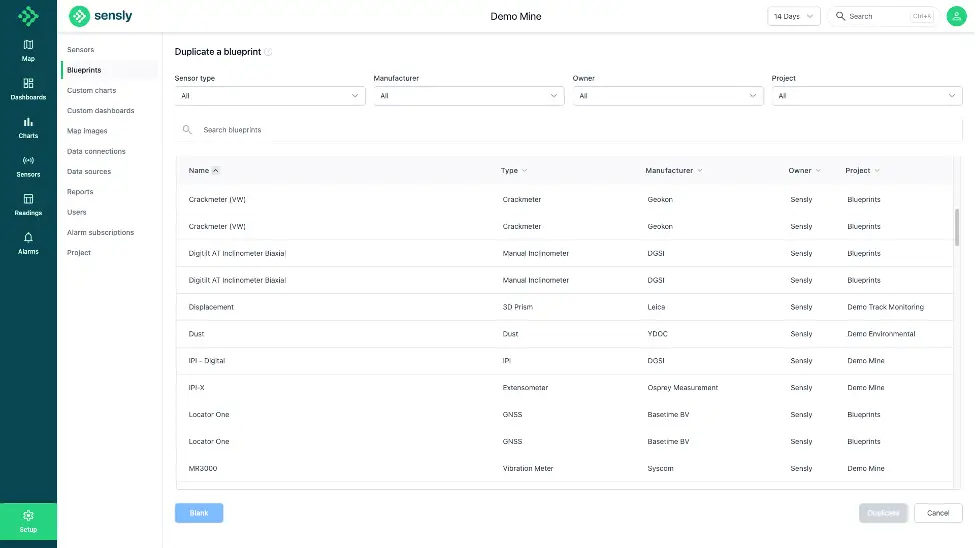

Sensor Blueprints define how a sensor behaves within Sensly. This includes how raw data is interpreted, how calculations are applied, and how the data is presented within the platform. By capturing this logic once, teams avoid the need to repeatedly configure the same parameters for each individual sensor.
Blueprints include transformation logic, units, calibration handling, naming conventions and default visualisation settings. Sensly maintains a library of standard blueprints for common sensor types, allowing teams to deploy sensors with a known, validated configuration. This reduces variability between projects and ensures consistency in how data is structured from the outset.
Blueprints can also be reused and adapted at the project level. Once a configuration has been established for a specific client or monitoring approach, it can be duplicated and applied across future deployments, supporting repeatability and reducing setup time.
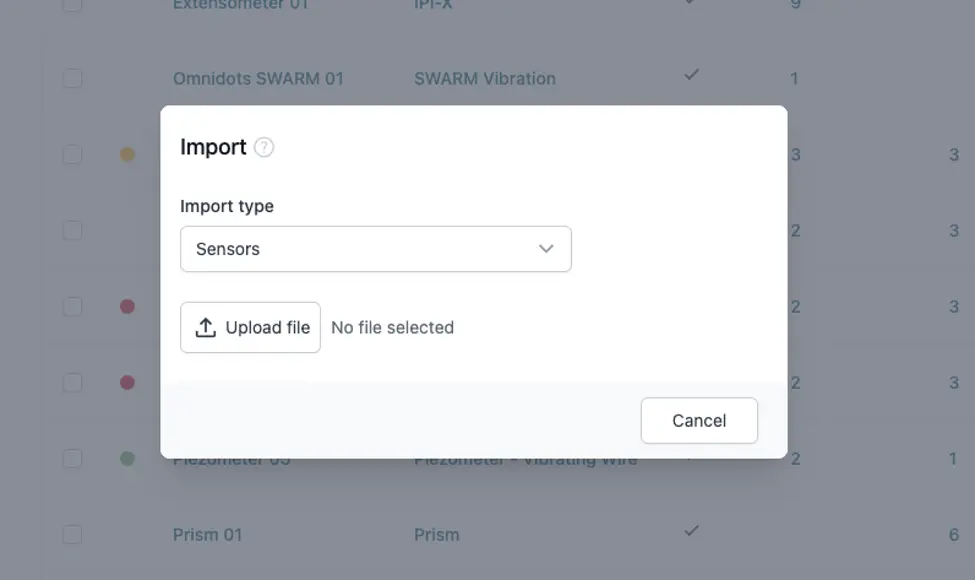

Sensly supports the application of blueprints at scale through structured import tools and APIs. Sensors can be created, configured and updated in bulk using CSV imports or programmatic workflows, enabling large sensor networks to be deployed efficiently.
This approach removes the need for repetitive, sensor-by-sensor configuration. Instead, teams can define datasets externally and apply consistent configurations across hundreds of sensors in a single operation. Calibration data, parameters and alarm thresholds can also be applied in bulk, ensuring alignment across the monitoring system.
By shifting configuration into structured workflows, Sensly reduces manual effort during mobilisation and improves overall data integrity.

Sensly’s API enables programmatic control over sensor configuration, allowing integration with external systems and supporting automated deployment workflows for large or complex projects.
The API also supports the secure movement of sensor readings into and out of the platform, enabling automated data ingestion from third-party sources and the distribution of processed data to client systems, dashboards, or internal workflows. This allows Sensly to operate as part of a broader monitoring ecosystem while reducing manual handling and improving data availability.

Structured CSV imports allow teams to define and upload large sensor datasets efficiently. This provides a controlled and auditable method for bulk configuration during project setup.
Import workflows can be used to upload sensor details, calibration information, alarm settings, and data mapping requirements in bulk, reducing manual entry and setup time. This enables large projects to be configured consistently, with a clear and auditable process for establishing sensors and their associated rules within the platform.

All sensors and their associated parameters are managed within a unified data model. This ensures that configuration, metadata and behaviour are consistently structured across the platform, supporting downstream processing and reporting.
In addition to sensor-specific information, the model also supports the capture of broader project context such as installation details, maintenance events, site areas, and other operational records. This means important contextual information is not fragmented across different systems or stored in separate documents, but is instead linked directly to the relevant assets within the software. As a result, all key technical and project metadata can be accessed in one place, improving traceability, consistency, and ease of reporting.
Sensly provides a set of tools that allow engineering teams to move from individual sensor setup to repeatable, systemised configuration workflows.